Loading component...
Section 5: Frequently asked questions
Requirements
No – the Professional Bodies acknowledge the obligations of TEQSA or NZQA registered providers in granting advanced standing in their programs in alignment with the AQF’s or NZQF’s qualification pathways policies.
No – the Professional Bodies acknowledge the obligations of TEQSA or NZQA registered providers to meet higher education standards for course design and delivery including student to staff ratios and maximum class size.
The Professional Bodies acknowledge the obligations and expertise of all TEQSA and NZQA recognised providers to ensure reliable assessment methods and ongoing academic integrity within their accredited program/s and as such do not stipulate specific assessment requirements or hurdles.
For further guidance on assessment design and academic integrity we refer you to the following key resources:
TEQSA website: Protecting Academic Integrity
NZQA website: Aromatawai and the Principles of Assessment
IFAC website: International Education Standard 6 (IES 6) AssessmentThe Professional Accounting Bodies are using Risk-based Accreditation Review Process (RARP) to assess and monitor accounting programs based on the potential risks to meeting accreditation standards.
This process involves identifying and evaluating risks that could impact the quality of the accredited accounting program and then directing efforts toward the areas where these risks are most critical. Providers are identified as either Category 1 or Category 2 Providers as shown below.
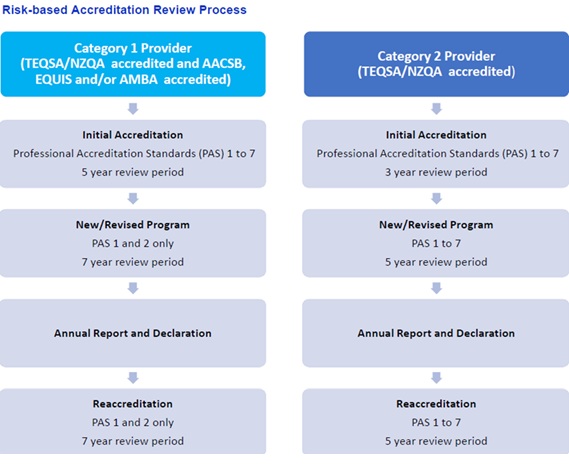
The Professional Bodies will only accredit programs that lead to a higher education award (for example, a bachelor’s or master’s degree).
Category 1 Providers are institutions registered with TEQSA or NZQA and hold accreditation from at least one of the following bodies: AACSB, EQUIS, or AMBA.
Category 2 Providers are institutions registered with TEQSA or NZQA but do not possess accreditation from any of the above organisations.
For twinning arrangements, assessment of the program will focus on the:
- program approval by relevant higher education agencies
- equivalence of curriculum
- quality of instruction
- reliability of assessment
- adequate and accessible facilities.
See Appendix 4: Twinning arrangements for further information on these factors.
For twinning arrangement accreditation submissions, providers are to use Template 1.
The Professional Bodies require all accredited programs to apply for reaccreditation every seven years for Category 1 providers and five years for Category 2 providers. In order to be reaccredited by the Professional Bodies, the program must meet the accreditation standards and criteria current at the time.
The Professional Bodies reserve the right to review a program or conduct a site visit outside the standard accreditation cycle.
- We expect that the software will be a commercial accounting package (there are many on the market, including MYOB and Xero). Use of a spreadsheet or database package, or software specially developed for teaching accounting, won't normally meet this requirement.
Process
There are no fees payable by a higher education provider to apply for accreditation by the Professional Bodies. The Professional Bodies invest in accreditation as part of their broader academic commitments.
The Professional Bodies will conduct a site visit for the first program accreditation submission by a new higher education provider and the reaccreditation review (if required) which occurs every seven years for Category 1 providers and five years for Category 2 providers. Where possible, each site visit will be conducted by representatives of both Professional Bodies. The Professional Bodies reserve the right to conduct a site visit outside the standard accreditation cycle.
The initial site visit will take place during the assessment stage of the accreditation process. At the site visit, representatives of the Professional Bodies will identify any areas of concern, and the higher education provider must address these areas before the application will be considered for accreditation by the Professional Bodies. If the provider is operating a twinning arrangement, and the Professional Bodies have not previously visited the twinning partner campus, then a site visit to that campus will normally be required.
The reaccreditation site visit will be a requirement for providers within their first 10 years of accredited program delivery and recommended for more established providers.
If a provider introduces a new accredited program during their seven-year review cycle for Category 1 providers and five-yearly review cycle for Category 2 providers, the new program will need to be included in the next review submission regardless of whether the initial accreditation of that program was less than seven/five years ago. This is to streamline processes for all stakeholders and align subsequent review cycles to the same period.
Obligations
Once a program is accredited by the Professional Bodies, we request that the provider:
- provides confirmation/update of subject tables annually. We’ll send an email request to the provider’s nominated contact for response. Failure to supply timely information may result in program details being removed from our website
- inform us of any proposed significant changes to the program via submission of Template 2.
Major changes will be reviewed by the Professional Bodies’ relevant accreditation committee. Changes may impact the accredited status of the program.
Should the Professional Bodies accreditation standards not be met, the program will not be reaccredited. Similarly, should either professional body become aware of a significant change to an accredited program that results in the accreditation standards not being met, accreditation of this program can be withdrawn by the Professional Bodies.
Program changes
A major change is anything that impacts on how the provider or accredited program complies with the Professional Bodies' accreditation standards and competency areas. Examples can include, but are not limited to:
- change of ownership or legal control of higher education provider
- change of program or provider accreditation status with TEQSA or NZQA
- change to AQF or NZQF award level or title
- changes to key staff within the School of Accounting
- changes to program delivery locations/campuses
- changes to mode of delivery
- changes to program structure or content associated with required competency areas
- program cessation.
Complete Template 2 and email through to [email protected] and [email protected]. The accreditation status of the program will be reviewed by the Professional Bodies and you will be advised in writing of the outcome of this review.
Email details of the change/s through to [email protected] and [email protected] to ensure the program name is updated on both the Professional Bodies’ websites.
- Email details of the change through to [email protected] so we can update the program name on our website.
Complete Template 2 and email through to [email protected] and [email protected]. This will then be assessed by the Professional Bodies and we will advise as to whether the changes will impact the accredited status of the program.
Program promotion
If a program is accredited, you will receive an accreditation certificate to display on campus and allowed to use our logo on marketing material for the program (in accordance with respective guidelines). The accredited program will also be listed on the Professional Bodies’ websites.
Yes, we have set requirements with how the logo, trademarks and brand are used. Contact the Professional Bodies for help with using the logo on marketing materials.
Both the Professional Bodies publish a dynamic list of accredited programs on their websites. In efforts to provide accurate information about accredited programs available to members and potential members of the Professional Bodies and the broader community, we require the assistance of higher education providers to maintain the listing via timely submission of their annual reports and notification of any changes outside this reporting period as soon as possible.
Links to the profession
In support of developing well-rounded, work-ready graduates, the Professional Bodies welcome the inclusion of WIL in accounting degrees across a range of formats, including:
- professional work placements
- internships, practicum, field or clinical placements
- cooperative education
- service learning
- community projects
- industry projects
- work-based projects
- fieldwork
- site visits, field observations and shadowing.
The Professional Bodies welcome opportunities to promote such activities to members and invite their involvement.
The WIL may also contribute towards the practical experience requirement for the professional programs of both Professional Bodies.
Higher education providers are encouraged to invite members and representatives of the Professional Bodies to have input into the program development process via program advisory committees or review panels. Ideally, the appointed persons would include employers of program graduates in order to provide a "marketplace" view of the education needs of the industry, as well as feedback on the accounting programs offered and the standards achieved by graduates.